
Insights
Client Alert: July 23, 2026
U.S. Trade Representative announced the results of the Section 301 investigation

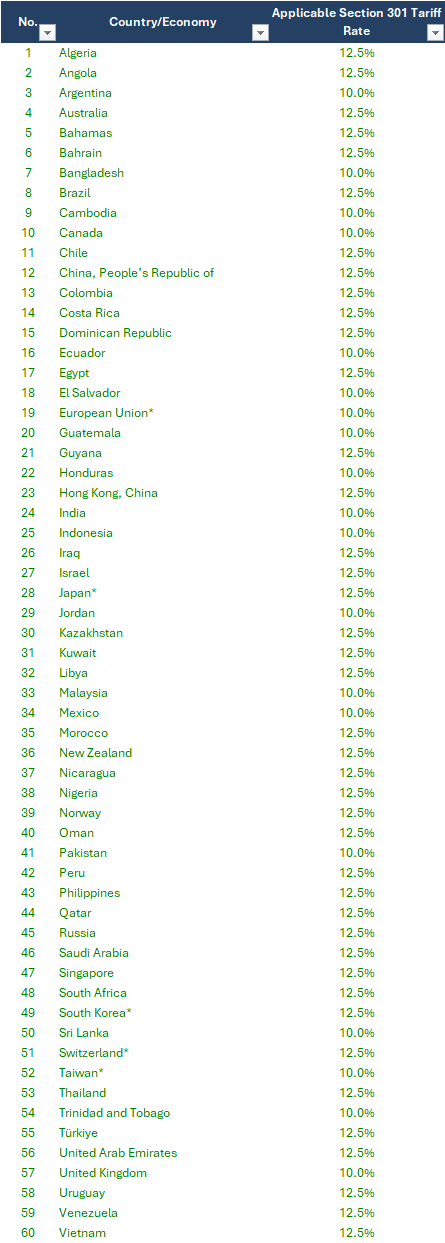
On July 23, 2026, the U.S. Trade Representative announced the results of the Section 301 investigation into unfair trade practices of 60 U.S. trading partners as it relates to alleged deficient forced labor prevention measures. The new tariffs for covered products begin at 12:01 am EDT on July 24, 2026. For cargo that is already on the water, the rates apply starting at 12:01 a.m. EDT on July 28, 2026. There are also many exempt goods from the Section 301 (forced labor) tariffs by HTS code as listed in the Annex II of the Federal Register Notice to be published soon. Annex II includes goods that are exempt from all 60 countries as well as lists that apply to specific countries of origin. Below is a summary of the Section 301 (forced labor) tariffs by country. Countries with * after the names indicate that the Section 301 duty is the amount necessary to bring the combined MFN and Section 301 rate to 10%. If the MFN rate is already 10% or higher, the Section 301 duty is zero.
Client Alert: July 17, 2026
DOJ and DHS Issue Joint “Resource Guide to Trade Fraud Enforcement”: What Companies Need to Know
DOJ and DHS Issue Joint “Resource Guide to Trade Fraud Enforcement”: What Companies Need to Know
EXECUTIVE SUMMARY
On July 6, 2026, the DOJ-DHS Trade Fraud Task Force released a joint Resource Guide to Trade Fraud Enforcement, consolidating the government’s civil, criminal, and administrative playbook for customs and trade violations.
The Guide follows Executive Order 14411, “Strengthening Customs Enforcement” (June 3, 2026), which directs CBP to maximize liquidated damages claims, restrict in-bond privileges, expand audits, and impose maximum broker penalties.
Importers of Record and Customs brokers face a non-delegable duty of “reasonable care” that cannot be contracted away to freight forwarders, suppliers, or brokers.
Enforcement spans the full spectrum: CBP administrative penalties (19 U.S.C. §§ 1592, 1595a(b)), the civil False Claims Act (treble damages, qui tam suits), Title 18 smuggling and false statement statutes (up to 20 years’ imprisonment), money laundering, RICO, and securities-law books-and-records exposure for issuers.
Forced-labor enforcement is a standalone priority, anchored by Section 307 Withhold Release Orders/Findings and the UFLPA rebuttable presumption for goods with any nexus to Xinjiang or 12 other high-priority sectors.
Recent resolutions illustrate the stakes: $549.5 million (AD/CVD evasion), $1.6 billion (emissions fraud), and $365 million (misclassification) settlements/resolutions in recent years.
Bottom line: DOJ and DHS expect companies to treat trade compliance as a board-level risk management priority — auditing supply chains, verifying counterparty representations, and avoiding willful blindness.
The Guide and Its Issuing Agencies
On July 6, 2026, the Trade Fraud Task Force — a joint initiative of the U.S. Department of Justice (“DOJ”) and the U.S. Department of Homeland Security (“DHS”) — published A Resource Guide to Trade Fraud Enforcement (the “Guide”). The Task Force includes DOJ’s National Fraud Enforcement Division, Criminal Division, Civil Division, and Environment and Natural Resources Division; the U.S. Attorney’s Office for the Northern District of Illinois; DHS’s Homeland Security Investigations (“HSI”), part of U.S. Immigration and Customs Enforcement; and U.S. Customs and Border Protection (“CBP”).
The Guide is not a regulation and creates no new private rights or defenses, but it is a candid statement of enforcement priorities and methods. For companies that import goods into the United States — or that sit downstream in a supply chain touching imported goods — the Guide is best read as a roadmap of where DOJ and DHS intend to look next.
Why It Matters Now
The Guide arrives amid a demonstrably more aggressive enforcement posture. On June 3, 2026, the President issued Executive Order 14411, “Strengthening Customs Enforcement,” directing CBP to make full use of its administrative toolkit against systemic compliance failures. Pursuant to the Order, CBP is now: enforcing liquidated damages claims against import bonds for noncompliance; restricting in-bond utilization; increasing compliance audits; and imposing maximum penalties on brokers who fail to conduct due diligence, repeatedly represent noncompliant clients, or fail to cooperate promptly with CBP information requests. We have seen a significant spike among our clients receiving CF28 Requestion for Information to verify country of origin.
The Guide is equally direct about corporate oversight expectations. DOJ states plainly that “the era when a company can claim ignorance of its upstream partners’ activities is over.” Every participant in the supply chain — importer, wholesaler, transporter — is expected to audit its supply chain, verify counterparty representations, and avoid willful blindness to red flags in pricing, sourcing, or documentation. In assessing corporate liability, DOJ says it will look closely at whether a compliance failure reflects negligence, reckless disregard, willful blindness, or intentional criminality — language that tracks the culpability spectrum DOJ applies in other regulatory-enforcement contexts (e.g., export controls and sanctions) and signals that boards and C-suites, not just compliance staff, are expected to own this risk.
The Customs Entry Process: IOR and Broker Obligations
The Guide devotes substantial attention to the mechanics of the entry process, underscoring that most trade fraud enforcement traces back to false or incomplete statements made at entry and the legal duty of care for importers under customs law – “reasonable care”.
The Guide also flags the growing significance of “external revenue authorities” layered on top of ordinary tariff schedules — Section 301, Section 232, Section 201 global safeguards, and antidumping/countervailing duty (“AD/CVD”) orders, which can exceed 100% — and in some cases 600% or more — of declared value. These elevated duty rates are precisely what create the financial incentive for the fraud typologies discussed below.
Civil and Criminal Enforcement Tools
The Guide catalogs an unusually broad range of enforcement mechanisms, reflecting DOJ and DHS’s view that trade fraud should be met with the full suite of available remedies rather than administrative penalties alone.
CBP Administrative Authority
Under 19 U.S.C. § 1592 (“Section 592”) and 19 U.S.C. § 1595a(b), CBP may impose civil administrative penalties for negligent, grossly negligent, or fraudulent entries, with penalty ceilings scaling with the level of culpability, and may seize merchandise entered contrary to law.
Civil False Claims Act
The civil False Claims Act, 31 U.S.C. §§ 3729–3733, is one of DOJ’s primary tools for customs duty evasion, most often through “reverse false claims” theories — i.e., knowingly avoiding an obligation to pay duties owed to the government. The FCA carries treble damages and per-claim penalties, and its qui tam provisions allow private whistleblowers (including competitors and former employees) to file suit on the government’s behalf and share in any recovery, which has made it a leading driver of large-dollar customs settlements.
Criminal Statutes
Title 18 contains a cluster of criminal provisions specifically addressed to “fraud upon the customhouse”: 18 U.S.C. §§ 541 (entry of goods falsely classified), 542 (entry of goods by means of false statements), 545 (smuggling, punishable by up to 20 years’ imprisonment), 548, 550, and 551. The Guide emphasizes that Section 545 and related provisions reach not only the importer but down-chain actors — anyone who knowingly receives, conceals, buys, sells, or facilitates the transport or sale of goods imported contrary to law — and that conspiracy and aiding-and-abetting liability under 18 U.S.C. §§ 2 and 371 extend exposure further still.
Money Laundering and RICO
Transactions over $10,000 involving the proceeds of trade fraud can trigger money laundering charges under 18 U.S.C. §§ 1956–1957. Where trade fraud is sufficiently organized and repeated, the Racketeer Influenced and Corrupt Organizations Act (18 U.S.C. §§ 1961–1968) is also in play — a statute the Guide notes can reach corporate executives who did not personally commit the underlying fraud, and which carries up to 20 years’ imprisonment, forfeiture, and (for private plaintiffs) treble damages.
Health, Safety, and Securities Exposure
The Guide also cross-references the Federal Food, Drug, and Cosmetic Act, the Consumer Product Safety Act, and the Lacey Act’s criminal provisions for regulated or dangerous goods, and flags federal securities law exposure for public-company issuers — specifically the books-and-records and internal-controls provisions of Section 13(b)(2) of the Securities Exchange Act, 15 U.S.C. § 78m(b)(2), and related disclosure obligations where trade fraud liabilities are material.
Forced Labor Enforcement
The Guide devotes a full chapter to forced labor, which DOJ and DHS frame as both a humanitarian and a national security priority.
Section 307 (19 U.S.C. § 1307): prohibits entry of goods made with forced labor. CBP may issue a Withhold Release Order (“WRO”) on reasonable suspicion, or a Finding on probable cause, which can result in seizure and forfeiture.
Uyghur Forced Labor Prevention Act (Pub. L. 117-78): creates a rebuttable presumption that goods mined, produced, or manufactured wholly or in part in Xinjiang, or by an entity on the UFLPA Entity List, are made with forced labor and barred from entry. Importers must rebut this presumption with “clear and convincing” evidence — a demanding standard that requires granular, verifiable supply chain documentation.
Forced Labor Enforcement Task Force (FLETF) and the UFLPA Entity List: FLETF maintains and expands the Entity List, which importers should screen against on an ongoing basis, not merely at onboarding.
Twelve high-priority sectors: apparel, cotton, silica/polysilicon, tomatoes, aluminum, PVC, seafood, steel, copper, lithium, caustic soda, and jujubes — sectors that CBP and HSI are directing disproportionate enforcement attention toward.
Criminal exposure: Title 18, Chapter 77 (18 U.S.C. §§ 1589, 1592, 1593, 1593A, 1594) criminalizes forced labor and related trafficking offenses connected to imported goods, with mandatory restitution and forfeiture upon conviction.
Common Trade Fraud Typologies — and Recent Enforcement Examples
The Guide devotes its longest chapter to recurring fraud typologies. The typologies below are drawn directly from the Guide, illustrated with recent settlement and prosecution figures cited in the Guide and related DOJ/EPA press releases.
Valuation, Classification, and Origin Fraud
Manifest fraud — falsifying cargo manifests to misstate the nature, quantity, or origin of goods.
False country-of-origin declarations and markings — mislabeling goods to obscure their true origin, often to evade country-specific tariffs or AD/CVD orders.
False HTS classification — assigning an incorrect Harmonized Tariff Schedule code to secure a lower duty rate.
Undervaluation — understating the transaction value of imported goods to reduce ad valorem duties owed.
Antidumping/countervailing duty (AD/CVD) evasion — transshipment, mislabeling, or misclassification designed to avoid AD/CVD rates that can exceed 100%, and in some cases 600%, of declared value.
Structural and Programmatic Fraud
Shell company fraud — using shell entities to obscure the true importer, manufacturer, or beneficial owner and evade penalties or bond obligations.
Customs broker fraud — brokers who knowingly file false entries, fail to exercise due diligence, or facilitate a client’s scheme.
Drawback fraud (false export claims) — falsely claiming refunds of duties paid on imported goods that are supposedly re-exported.
Free Trade Agreement (FTA) fraud — falsely certifying that goods qualify for preferential duty treatment under an FTA when they do not meet rules-of-origin requirements.
Port shopping — routing entries through ports perceived as having weaker scrutiny or inspection capacity.
Health, Safety, and Environmental Fraud
Forged product safety or environmental certifications (e.g., CPSC/EPA fraud) — fabricating compliance certificates to secure entry of regulated goods.
Failure to report dangerous or defective products or adverse events — withholding required notifications to PGAs such as the Consumer Product Safety Commission.
False declaration of regulated commodities — including evasion of “prior notice” and import-alert requirements for regulated food products.
Illegal timber and wildlife laundering — disguising the species, origin, or legality of timber and wildlife products in violation of the Lacey Act, the Endangered Species Act, and related statutes.
Importing adulterated drugs and devices — introducing pharmaceuticals or medical devices that do not meet FDCA requirements.
Practical Corporate Compliance Takeaways
The Guide’s core message to industry is that trade compliance can no longer be treated as a back-office, logistics nerds’, check-the-box function. In light of EO 14411 and the enforcement examples above, we recommend that importers, brokers, and their counsel take the following steps:
Audit the supply chain, end to end. Conduct periodic, documented audits of suppliers, manufacturers, and intermediaries — including sub-tier suppliers — with particular attention to country of origin, valuation, and HTS classification support.
Independently verify counterparty representations. Do not rely solely on supplier certificates of origin, FTA qualification statements, or forced-labor attestations; corroborate with production records, site visits, or third-party audits where feasible.
Avoid willful blindness. Establish escalation protocols for red flags — pricing anomalies, inconsistent documentation, shell-entity indicators, or sourcing from high-priority forced-labor sectors — and document how red flags are investigated and resolved.
Remember the duty of reasonable care cannot be outsourced. IORs remain liable notwithstanding reliance on brokers or freight forwarders; broker relationships should be documented and monitored, not treated as a liability shield.
Screen against the UFLPA Entity List and high-priority sectors on a recurring basis, and build “clear and convincing” evidentiary files in advance for goods sourced from or near Xinjiang or the 12 high-priority sectors.
Reassess AD/CVD and FTA duty positions. Given duty exposure that can reach 100–600%+ of declared value, confirm classification and origin positions are supportable and consider a voluntary self-assessment or prior disclosure where issues are identified.
Treat trade compliance as enterprise risk management. Ensure C-suite and board-level visibility into trade compliance, given DOJ’s stated focus on whether failures reflect negligence, reckless disregard, willful blindness, or intent — and the securities-law books-and-records implications for public issuers.
Prepare for CBP’s expanded administrative posture. Anticipate more frequent audits, CF 28/29’s, liquidated damages claims, and in-bond restrictions under EO 14411, and ensure entry-level documentation can withstand heightened scrutiny.
Consider whistleblower exposure. Qui tam suits under the False Claims Act are a leading driver of large customs settlements; internal reporting channels and prompt investigation of complaints can mitigate this risk.
Conclusion
The recently published Resource Guide to Trade Fraud Enforcement confirms that DOJ and DHS view customs and trade fraud as a whole-of-government enforcement priority, backed by administrative, civil, and criminal tools that reach importers, brokers, corporate officers, and down-chain actors alike. Companies with import operations — or supply chains that touch high-priority sectors or heightened AD/CVD exposure — should treat the Guide’s publication as an occasion to reassess compliance programs now, before an audit, whistleblower complaint, or CBP audit/enforcement forces the issue.
Upcoming Webinar to be hosted by Swiss Medtech Association
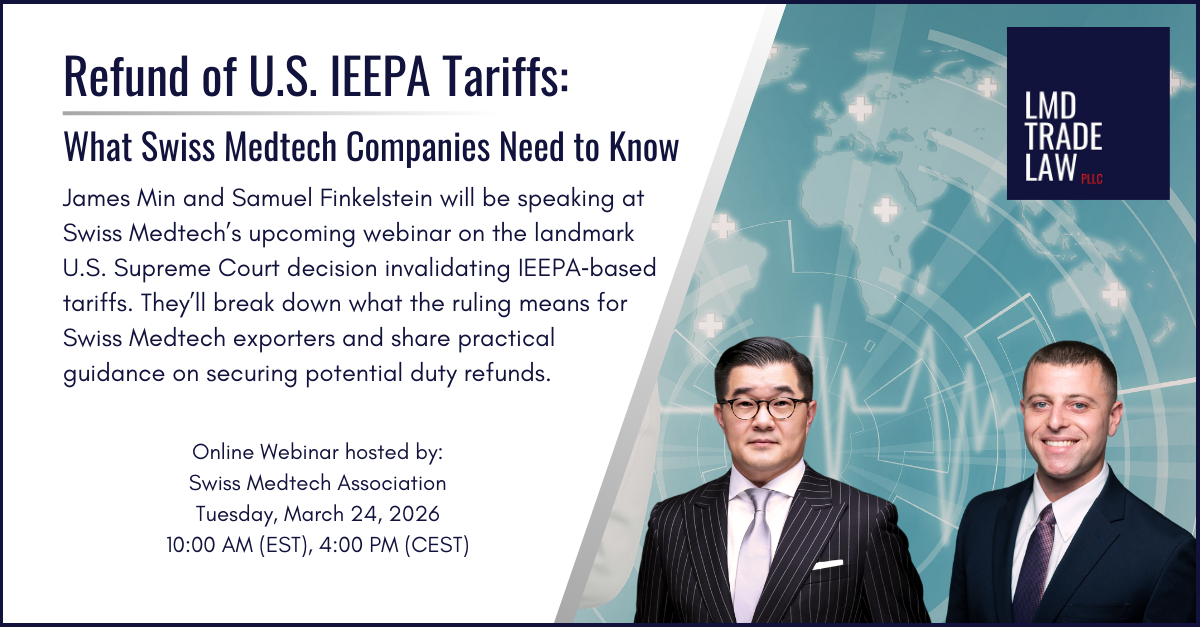
Participating Panelists: James Min, Managing Partner and Samuel D. Finkelstein, Associate
Client Alert: February 20, 2026
Supreme Court Strikes Down IEEPA Tariffs—Key Implications for Importers Seeking Refunds
Supreme Court Strikes Down IEEPA Tariffs—Key Implications for Importers Seeking Refunds
Today, the U.S. Supreme Court issued a landmark 6-3 decision holding that the International Emergency Economic Powers Act (IEEPA) does not authorize the President to impose tariffs. The ruling invalidates the tariffs that President Trump imposed beginning in early 2025 on imports from Canada, Mexico, China, and virtually all other U.S. trading partners.
For importers who have paid these tariffs, this decision opens the door to seeking refunds, though significant unanswered questions remain about the process and timing for doing so.
Background: The Tariffs at Issue
In 2025, President Trump invoked IEEPA to declare national emergencies based on (1) illegal drug trafficking from Canada, Mexico, and China, and (2) large and persistent U.S. trade deficits. Relying on these emergency declarations, the President imposed:
A 25% tariff on most imports from Canada and Mexico;
Tariffs on Chinese goods that ultimately reached 145%; and
"Reciprocal" tariffs of at least 10% on imports from all other trading partners.
Additional penalty tariffs targeting imports from Brazil and India.
These tariffs were challenged in two consolidated cases—one brought by small businesses and another by small businesses joined by 12 states.
What the Court Said (and did not say)
Writing for the majority, Chief Justice Roberts held that IEEPA does not authorize the President to impose tariffs, meaning that the tariffs imposed under IEEPA lacked statutory authority. The decision establishes that the IEEPA tariffs were unlawful, which means importers who paid them have a legal basis to seek refunds from the U.S. government.
However, the Court's opinion provides little guidance on the mechanics of refund recovery. The question of how duty refunds will be made available to affected importers now falls to the Court of International Trade to resolve.
The Court Did Not Address Remedies: The majority opinion does not elaborate on how or when importers will receive refunds. Justice Kavanaugh's dissent criticized the Court for saying "nothing today about whether, and if so how, the Government should go about returning the billions of dollars that it has collected from importers."
Jurisdiction Lies with the Court of International Trade: The Supreme Court confirmed that the Court of International Trade (CIT) has exclusive jurisdiction over tariff-related claims under 28 U.S.C. § 1581(i)(1). This means importers seeking refunds will likely need to pursue claims in the CIT or through administrative channels with U.S. Customs and Border Protection (CBP).
Remaining Questions
While today's ruling is a significant victory for importers, substantial uncertainty remains:
Administrative vs. Judicial Remedies. It is unclear whether CBP will establish an administrative refund process or whether importers will need to file individual or class actions in the Court of International Trade (CIT). More than one thousand cases before the CIT—where importers sought relief from the IEEPA tariffs—were stayed, pending the Supreme Court’s decision. Now, importers should closely monitor ongoing CIT litigation, as these cases may shed light on how refunds will be handled. Forthcoming guidance from CBP may also provide information regarding refunds.
Termination of Duty Collection. With the IEEPA tariffs now declared unlawful, CBP will need to cease collecting IEEPA tariff duties from importers. This will require modifications to the Harmonized Tariff Schedule of the U.S. (HTSUS), and will not happen automatically. Importers should watch for guidance via CBP’s Cargo Systems Messaging Service (CSMS) for updates on the phase-out of IEEPA tariffs.
Statute of Limitations. Claims for refunds of duties under 28 U.S.C. § 1851(i) are generally subject to a two year statute of limitations, beginning after the cause of action first accrues. If the accrual date in this case is tied to the date of duty payment or liquidation rather than the date of the Supreme Court’s ruling, some claims could potentially become time-barred as early as 2027.
De Minimis Exemption. In 2025, President Trump also invoked IEEPA to suspend the de minimis exemption (19 U.S.C. § 1321) for low-value imports from all countries. The Supreme Court did not opine on whether IEEPA authorizes the President to take this action, which is the subject of separate litigation. However, given today’s decision, it is possible that the courts may rule that IEEPA did not authorize the suspension of de minimis either, potentially opening the door to further refunds.
Timeline. Given the complexity and scale of the refunds involved, the process could take months or even years to resolve.
Recommended Next Steps
We recommend that affected importers take the following steps:
Preserve Records. Importers should compile and preserve all documentation related to tariff payments, including CBP entry summaries, commercial invoices, proof of payment, and any correspondence with CBP. Calculate the total amount of IEEPA tariffs paid to date to assess the magnitude of potential refund claims.
Monitor Liquidation Timelines. Importers should identify unliquidated entries, as these present the clearest path for reversing payment of the invalidated tariffs. If CBP does not automatically correct unliquidated entries to remove the IEEPA tariffs, importers should consider filing Post Summary Corrections (PSCs) to amend their entry summaries and claim the correct duty rate. PSCs must generally be filed before liquidation occurs, so timely action is critical. Importers should work with their customs brokers to monitor liquidation status and be prepared to act quickly.
Track New Developments. Importers should monitor guidance from CBP and the Court of International Trade regarding the refund process and cessation of IEEPA duty collection.
Evaluate Litigation Options. Depending on how the refund process unfolds, importers may need to consider filing claims in the Court of International Trade, either individually or as part of a class action.
Consult with Counsel. Given the complexity and evolving nature of this issue, we encourage you to contact us to discuss your specific circumstances and develop a strategy tailored to your business.
Attorney Advertising: These materials were prepared for general informational purposes only based on information available at the time of publication and are not intended as, do not constitute, and should not be relied upon as, legal advice or a legal opinion on any specific facts or circumstances. LMD Trade Law PLLC (and its attorneys and employees) shall not have any liability in connection with any use of these materials. The sharing of these materials does not establish an attorney-client relationship with the recipient and should not be relied upon as an alternative for advice from qualified counsel. Please note that facts and circumstances may vary, and prior results do not guarantee a similar outcome.
LMD Trade Law PLLC Adds Haley Kim as Counsel and Lal Bilgili as Associate
LMD Trade Law PLLC is pleased to announce that Jonathan S. Hale has joined the firm as Of Counsel, bringing more than 25 years of legal, foreign policy, and international trade experience to support our clients navigating today’s complex and challenging global regulatory landscape.



LMD Trade Law PLLC is pleased to announce two new additions to the firm; Haley (Hak) Kim has joined the firm as Counsel and Lal Bilgili has joined as an Associate.
Haley Kim’s new role as Counsel in the firm will help strengthen our capabilities across economic sanctions, export controls, customs, CFIUS, data privacy and security, and international trade compliance. Ms. Kim brings significant experience advising multinational corporations, start‑ups, and nonprofits in sectors including semiconductors, artificial intelligence, biotechnology, life sciences, logistics, apparel, and media.
Ms. Kim has counseled clients on U.S. sanctions and export controls involving Russia, China, Iran, North Korea, Syria, and Cuba, conducted internal investigations, and prepared voluntary disclosures to OFAC that resulted in no penalties. She has supported clients in OFAC subpoena responses, secured OFAC licenses for nonprofit and media organizations, and represented importers in forced labor enforcement matters before U.S. Customs and Border Protection, successfully obtaining release of detained shipments. She has also advised technology-based companies on CFIUS and data security matters.
Earlier in her career, Ms. Kim served as the general counsel at a Korean shipping company, managing M&A, bankruptcy proceedings, and cross‑border commercial disputes. She earned her LL.M. in International Economic Law, Business & Policy from Stanford Law School and her J.D. from Ewha Womans University Law School. She is admitted to practice in California and South Korea.
The addition of Lal Bilgili as Associate, brings a strong international background and growing expertise in global regulatory matters.
Ms. Bilgili is licensed in New York** after recently completing her Juris Doctor at the University of Southern California Gould School of Law, where she served as Senior Editor of the Southern California Law Review. She also holds a Master of Arts in Human Rights from University College London and B.A. in Political Science and Russian from the University of Southern California.
At LMD Trade Law PLLC, Ms. Bilgili assists with a wide range of matters, including economic sanctions, export controls, customs regulations, CFIUS, international logistics, and national‑security–related legal issues, helping clients navigate rapidly evolving global compliance challenges.
Her prior professional experience includes roles as a summer associate and legal intern at LMD Trade Law, other firms in Los Angeles and Washington, D.C., where she focused on international trade law. She also worked with White & Case LLP in London and Istanbul on multi‑jurisdictional M&A and commercial transactions, and served as a legal intern at Credit Europe Bank in Moscow, supporting cross‑border financial matters.
Originally from Istanbul, Turkey, she speaks Turkish, English, French, and Russian, further strengthening the firm's multilingual and international capabilities.
“We are delighted to welcome Haley and Lal as they begin their new roles within LMD,” said James Min, Managing Partner of LMD Trade Law PLLC. “Their academic achievements, international experience, and commitment to excellence will significantly enhance our ability to support clients operating in complex and fast‑moving global regulatory environments.”
Haley’s full bio and contact information can be found here.
Lal’s full bio and contact information can be found here.
**Not Licensed to Practice Law in the District of Columbia. Admitted to the New York State Bar on January 29, 2026. Works Under the Supervision of a D.C. Bar Member.
LMD Trade Law PLLC Adds Jonathan S. Hale from the U.S. Senate
LMD Trade Law PLLC is pleased to announce that Jonathan S. Hale has joined the firm as Of Counsel, bringing more than 25 years of legal, foreign policy, and international trade experience to support our clients navigating today’s complex and challenging global regulatory landscape.

LMD Trade Law PLLC is pleased to announce that Jonathan S. Hale has joined the firm as Of Counsel, bringing more than 25 years of legal, foreign policy, and international trade experience to support our clients navigating today’s complex and challenging global regulatory landscape.
Mr. Hale’s distinguished career is anchored by his senior leadership roles in the U.S. Senate, where he served as General Counsel to U.S. Senator Maria Cantwell, Senior Counsel on the Senate Commerce, Science, and Transportation Committee, and Staff Director of the Senate Committee on Small Business and Entrepreneurship. In these roles, he led bipartisan legislative initiatives on artificial intelligence, quantum technologies, international trade, and supply chain resilience. Beyond the U.S. Senate, Mr. Hale was a presidential appointee at the U.S. Department of State—where he led global supply chain diplomacy—and at the U.S. Agency for International Development as a Deputy Assistant Administrator for Europe and Eurasia overseeing major foreign assistance programs and interacting with the U.S. National Security Council and interagency task forces. Earlier in his career, he advised Fortune 100 and Fortune 500 companies in private practice at Baker Botts LLP and a boutique economic sanctions law firm.
“Our clients will benefit from Mr. Hale’s deep understanding of how policies and laws are made and implemented at the highest levels of the U.S. Government. His addition further strengthens our capacity to service our global clients,” said James Min, Managing Partner of LMD Trade Law PLLC. Mr. Hale’s ability to translate complex legislative and regulatory developments into strategic, actionable guidance will strengthen our clients’ capacity to anticipate challenges, seize opportunities, and operate confidently in a rapidly evolving global environment.
Jonathan’s full bio and contact information can be found here.
Client Alert: December 8, 2025
Major U.S. Importers File CIT Lawsuits To Preserve IEEPA Tariff Refund Rights
Major U.S. Importers File CIT Lawsuits To Preserve IEEPA Tariff Refund Rights
A growing number of large U.S. importers including Costco are filing protective lawsuits in the U.S. Court of International Trade (CIT) to preserve their rights to duty refunds in case the Trump Administration’s IEEPA-based tariffs are struck down by the U.S. Supreme Court. With billions of dollars at stake, companies are moving quickly to ensure that they are not foreclosed from obtaining duty refunds if the Court’s decision does not automatically extend relief to all affected importers.
Possible Outcomes Of The U.S. Supreme Court IEEPA Tariffs Case
The U.S. Supreme Court in V.O.S. Selections v. Trump, for which oral arguments were heard on November 5, 2025, could rule that the IEEPA-based tariffs are unlawful. One potential outcome—speculative, but meaningful from a risk management perspective—is that the Court may not address the refund process or it may grant relief/refunds only to the named plaintiffs in the case before it, without automatically extending that relief to all similarly situated importers. In that latter scenario, companies that did not file protests with CBP for liquidated entries or initiated CIT actions could find themselves without a viable refund pathway, unless Customs & Border Protection (CBP) were to provide an administrative refund process.
A second possibility is that the Court could hold the tariffs unlawful but remand the case to lower courts to determine who is entitled to refunds. This occurred in the well-known Harbor Maintenance Fee (HMF) litigation, where the U.S. Supreme Court in 1998 struck down the fee as a constitutionally prohibited export tax, but left it to lower courts to determine the availability of refunds. That process took years, during which many exporters lost their ability to recover the invalidated fees that they had paid. The legacy of the HMF litigation is a cautionary lesson: even when the underlying fee or duty is held unconstitutional, refund eligibility can hinge on whether a trader has already preserved its individual claims.
Why Filing In The CIT Matters: Preserving Refund Rights Post-Liquidation
Under U.S. customs law, importers can amend their entries through a post-summary correction (“PSC”) before liquidation or challenge duties it was levied by CBP once CBP “liquidates” an entry (i.e., when CBP formally finalizes the duty assessment). CBP typically liquidates entries within 10 months of importation or within one year by operation of law. Following liquidation, an importer’s refund rights are sharply reduced. Importers have up to 180 days after liquidation to file a protest with CBP, and if that deadline is missed, the entry becomes final and unreviewable. It is possible for the courts to mandate that affected past entries be reliquidated, but that is not guaranteed. At that point (180 days after liquidation), even if the tariff is later ruled unlawful, the importer may not be able to obtain a refund unless it has a pending CIT case enjoining the liquidation of their entries as well as contesting the legality of the IEEPA tariffs.
A CIT lawsuit therefore can function as a protective tolling mechanism. It keeps the affected entries open for judicial review and ensures that the importer is not barred from seeking refunds if the U.S. Supreme Court’s ruling is favorable or remanded to lower courts to sort out the procedures.
Why These Cases Are Being Filed Now: The Liquidation/Protest Clock Is Ticking
The timing of the recent influx of CIT lawsuits is directly tied to the mechanics of liquidation:
CBP typically liquidates entries ~10 months after importation.
The earliest entries subject to the challenged IEEPA tariffs are now approaching liquidation, meaning importers face imminent deadlines to file a protest, a lawsuit (or both), or potentially risk losing refund rights.
Once liquidation occurs, importers have only 180 days to file a protest with CBP (a protest can cover multiple entries), after which the entry becomes finalized absent a pending protest or CIT litigation.
There are some legal questions of whether a protest can even be filed challenging the IEEPA tariffs because protests are for contesting actions by CBP but in this case, the IEEPA tariffs were actions by the President through Executive Orders and not CBP decisions on classification, valuation, country of origin or such.
For many importers, by the time the U.S. Supreme Court issues a decision and potentially the lower courts decide on the eligible persons for duty refunds or procedures, a substantial portion of their imports subject to IEEPA-tariffs may have already liquidated, and/or the protest window expired.
This is why a growing number of sophisticated importers are filing CIT lawsuits to challenge the IEEPA tariffs and to seek duty refunds. It is possible that the liquidation and protest timelines could close before the judicial process fully resolves the legality of the tariffs and scope of or manner of relief. Protective litigation may be a means of ensuring that refund rights do not expire while the courts deliberate.
Implications for Companies That Paid IEEPA Tariffs
The recent wave of CIT filings signals that many importers are making an affirmative choice to preserve their potential refund rights, rather than wait for the U.S. Supreme Court’s decision or for potential CBP administrative relief, if any. Given the looming liquidations of early importations from this year subject to IEEPA tariffs, companies with meaningful exposure may wish to evaluate the risks of inaction now.
Our firm is actively assisting clients in assessing litigation options, liquidation timelines, and strategies for filing protective CIT actions. It may be an opportune time to evaluate past 2025 importations (e.g. reviewing liquidation dates of customs entries and potential refund amounts) promptly to determine whether a protective lawsuit is warranted.
Attorney Advertising: These materials were prepared for general informational purposes only based on information available at the time of publication and are not intended as, do not constitute, and should not be relied upon as, legal advice or a legal opinion on any specific facts or circumstances. LMD Trade Law PLLC (and its attorneys and employees) shall not have any liability in connection with any use of these materials. The sharing of these materials does not establish an attorney-client relationship with the recipient and should not be relied upon as an alternative for advice from qualified counsel. Please note that facts and circumstances may vary, and prior results do not guarantee a similar outcome.
Client Alert: October 2, 2025
50% Rule Now For Export Controls Too - BIS Issues Interim Final Rule
BIS Issues Interim Final Rule Extending Entity List Controls to Majority-Owned Affiliates: On September 29, 2025, the U.S. Department of Commerce’s Bureau of Industry and Security (BIS) issued an interim final rule (the “Affiliates rule”) amending the Export Administration Regulations (EAR) and significantly expanding the reach of the BIS Entity List, Military End-User (MEU) List, and sanctions-related trade restrictions by extending such restrictions to majority-owned, non-U.S. subsidiaries of listed entities.
Modeled on the U.S. Treasury Department’s Office of Foreign Assets Control (OFAC) 50% rule, the Affiliates rule provides that any non-U.S. company that is owned, directly or indirectly, fifty percent or more by one or more parties already designated on the Entity List, the MEU List, or certain OFAC sanctions lists, even if not explicitly listed, will automatically be subject to the same licensing requirements and restrictions as the listed parent entity. In other words, companies that are not explicitly named on these restricted party lists may now be deemed covered for export restrictions solely because of their ownership structure.
The Affiliates rule clarifies that ownership interests held by multiple listed parties may be aggregated to meet the 50 percent threshold, and that the most restrictive set of licensing requirements applicable to any parent entity will apply. BIS has also introduced a new “Red Flag 29,” which obligates exporters, reexporters, and transferors to conduct enhanced diligence in cases where ownership information is unclear. In situations where exporters/reexporters cannot reasonably determine whether the 50 percent threshold is met, BIS expects companies either to assume that a license is required and obtain one, or to resolve the red flag through additional due diligence. The Affiliates rule further requires applicants for BIS licenses to disclose whether an end-user is covered by the Affiliates rule, including ownership percentages and the methodology used to make that determination.
Recognizing the compliance challenges created by this sudden expansion of trade restrictions, BIS has also announced a 60-day Temporary General License (TGL) authorizing certain transactions with newly-covered foreign affiliates to mitigate immediate disruptions while companies adjust internal due diligence and compliance processes. Foreign entities that become subject to trade restrictions under the Affiliates rule may petition BIS’s End-User Review Committee to seek exclusion from their listed parent’s designation.
The Affiliates rule represents one of the most consequential expansions of U.S. export controls in recent years. It will require U.S. and multinational companies to conduct due diligence to determine the ownership structures of non-U.S. counterparties not only for sanctions purposes, but now for export control purposes. Companies should review their compliance policies and procedures to include this new requirement if they handle U.S. origin goods, technologies, and software. Companies should move quickly to assess their exposure and ensure that their compliance programs are aligned with the new requirements.
If you have any questions, please do not hesitate to contact us.
Attorney Advertising: These materials were prepared for general informational purposes only based on information available at the time of publication and are not intended as, do not constitute, and should not be relied upon as, legal advice or a legal opinion on any specific facts or circumstances. LMD Trade Law PLLC (and its attorneys and employees) shall not have any liability in connection with any use of these materials. The sharing of these materials does not establish an attorney-client relationship with the recipient and should not be relied upon as an alternative for advice from qualified counsel. Please note that facts and circumstances may vary, and prior results do not guarantee a similar outcome.
Webinar: Leveraging the Nairobi Protocol
Participating Panelist: Samuel D. Finkelstein, Associate
September 3, 2025
Insights and Compliance With the U.S. Duty Free Provision for Medical Devices
Samuel Finkelstein, Associate with LMD Trade Law PLLC, was a panelist for a webinar hosted by the Swiss Medtech Association and Switzerland Global Enterprise to share his expertise on utilizing the U.S. duty free provision in Chapter 98, HTSUS for certain medical devices.
Potential Process for Duty Refunds if IEEPA Based Reciprocal Tariffs Are Struck Down by the Courts

Written by: James Min, Managing Partner and LMD Counsel
August 21, 2025
I. Introduction
This year has been eventful for importers and practitioners alike. The use of the International Emergency Economic Powers Act (“IEEPA”) for “reciprocal” tariffs has been novel. As a result, we have seen a burst of litigation challenging these new tariff measures. In the cases of V.O.S. Selections, Inc. v. Trump and Oregon v. Trump, plaintiffs have challenged the President’s authority to base increased tariffs on emergency powers provided by IEEPA, which allows the regulation of imports but not explicitly imposition of tariffs.[1] On May 28, 2025, the U.S. Court of International Trade (“USCIT”) held in the affirmative for the V.O.S. plaintiffs, which is now pending appeal.
This article is not about the merits of the lawsuits, but rather, on the hypothetical case if the plaintiffs prevail. What will happen to all the importers who were required to pay the “reciprocal” tariffs and how can they recover those potentially unlawful duties? Customs and Border Protection (CBP) collected over $28.5 billion in duties in July 2025, a 273% increase year-over-year. Given the large amount of money at issue, what are the mechanisms that importers could potentially use to recover those duties? Based on past cases, there may be a bifurcated duty refund process – court ordered and an administrative process – but as with many trade related issues these days, the potential process is not crystal clear.
II. A Bifurcated Refund Process?
If the courts ultimately strike down the IEEPA-based tariffs, the mechanism for refunding duties would likely proceed along two parallel tracks: (1) Importers who were plaintiffs in the litigation could obtain refunds directly via court order; and (2) Non-plaintiff importers may be able to seek refunds through CBP-administered procedures.
A. Track One — Court-Ordered Refund Process
For the plaintiffs in the IEEPA cases, the USCIT can both “enter a money judgment”[2] and “order any other form of relief that is appropriate,”[3] including directing CBP to reliquidate the plaintiffs’ covered entries and return unlawfully collected duties.
Depending on the court’s decision, CBP could liquidate or reliquidate plaintiffs’ entries at the lawful rate and issue refunds. Where plaintiff entries have already liquidated, liquidation does not categorically bar the court from ordering reliquidation or equivalent monetary relief to make plaintiffs whole.[4] The plaintiffs’ refunds would include both principal and statutory interest, as CBP must pay interest on excess duties[5] at the IRS overpayment rate, which adjusts quarterly[6] and generally runs from the duty deposit date until liquidation or reliquidation, and then through payment.
CBP refunds the importer of record for covered entries via ACH refund (if enrolled) or U.S. Treasury check. Filing CBP Form 4811 can change where the check is mailed, but not who is entitled to the refund.
B. Track Two — Administrative Refund Process
If USCIT’s injunction is affirmed and the final disposition strikes down the IEEPA-based tariffs, non-plaintiff importers may not automatically receive refunds. Instead, CBP could establish an administrative refund process, either announced through the Cargo Systems Messaging Service (CSMS) or through a new regulatory process. In prior contexts (e.g., Section 301 and Section 232 exclusion programs), CBP has allowed importers to pursue refunds through two mechanisms:
Unliquidated Entries: Importers may file Post-Summary Corrections (PSCs) in ACE to remove the unlawful tariff component from entry summaries. A PSC generally must be filed within 300 days of entry and no later than 15 days before the scheduled liquidation.
Liquidated Entries: Importers may file a protest under 19 U.S.C. § 1514 within 180 days of liquidation, arguing that the duties were “not required by law” and therefore refundable under 19 U.S.C. § 1520(a)(1). If CBP denies or fails to act on a protest, importers may request accelerated disposition under 19 C.F.R. § 174.22. After 30 days, the protest is deemed denied, which preserves the importer’s right to seek judicial review at the USCIT under 28 U.S.C. § 1581(a).
III. Legal Precedent: 1998 Harbor Maintenance Fee Case
A historical view of the Harbor Maintenance Fee (“HMF”), while not perfectly analogous to the IEEPA-based tariffs, offers some comparative value. The HMF was established by Congress in 1986 to fund harbor maintenance and initially applied to both imports and exports. In 1998, the U.S. Supreme Court ruled in United States v. U.S. Shoe Corp that the HMF, as applied to exports, violated the Export Clause of the U.S. Constitution. Pursuant to the Court’s decision, the HMF could no longer be collected on exports.
As a result, on August 28, 1998, USCIT ordered an immediate refund of undisputed export HMF payments to exporters who were also plaintiffs. The order applied to payments received by Customs within two years of an exporter's filing of a complaint with the court, and required plaintiff exporters to file a claim with CBP’s predecessor agency.
Subsequently, in 2000, the U.S. Court of Appeals for the Federal Circuit in Swisher International, Inc. v. United Statesheld that there is no limitation on the period within which a refund request may be filed under Customs Regulations, which were later implemented.[7] Exporters who never filed a complaint under the court procedure could seek HMF refunds administratively. The court also held Customs’ denial of an export HMF refund request was a protestable decision under 19 U.S.C. § 1514.
IV. Practical Considerations
It will be worthwhile to see whether the court’s treatment of litigants versus non-litigants differs, should the plaintiffs succeed on the merits of the IEEPA-tariff challenges, that is, whether the court’s judgement is limited only to plaintiffs in those cases or applicable to all importers. Presumably, CBP would have to implement a new regulatory process to accept refund requests or it could rely on preexisting procedures for protests or duty refunds. Either way, given the expansive nature of the IEEPA-based tariffs, the volume of refunds will likely be daunting.
Moreover, while the importers of record (IOR) qualify for refunds, the process would likely be complicated in cases of informal entries handled by intermediaries such as express consignment operators, who often serve as the nominal consignee and the IOR. Intermediaries may have to create their own refund processes to pass refunded duties and interest received from CBP onto their customers.
It is also possible that if the U.S. Government loses in court, it may seek alternatives to reimpose the tariffs under Section 301, 338, or other trade remedy provisions, further delaying duty refunds.
V. Conclusion
Ultimately, irrespective of the final judicial decision, disparate outcomes could result for smaller importers who lack ACH or ACE accounts with CBP or the resources to manage the process. To preserve their rights, IORs should continue to monitor the court cases and liquidation dates of their entries, file Form 4811 for address changes, and communicate with their customs brokers.
Given the magnitude of potential refunds in question, express delivery companies and customs brokers who may have served as the IOR should also consider establishing systems to track and disburse duty refunds they may receive for their customers.
For importers, the headaches of duty refunds would be a welcome problem to have. However, we will have to await the final judicial outcome to see how potentially the largest duty refund program in customs history would play out.
************
This article is provided for informational purposes only and is not intended to constitute legal advice nor does it create an attorney-client relationship with LMD Trade Law PLLC or its affiliates.
[1] 50 U.S.C. § 1702(a)(1)(B).
[2] 28 U.S.C. § 2643(a)(1).
[3] 28 U.S.C. § 2643(c)(1).
[4] See Shinyei Corp. of Am. v. United States, 355 F.3d 1297, 1312–13 (Fed. Cir. 2004); See Also Shinyei Corp. of Am. v. United States, 524 F.3d 1274, 1283–84 (Fed. Cir. 2008).
[5] 19 C.F.R. § 24.36(a)(1).
[6] 19 C.F.R. § 24.3a(c)(1) (2023) (customs refund interest uses the rate established under 26 U.S.C § 6621; § 6622).
[7] See current 19 CFR 24.24(e)(4).
Originally published by: American Association of Exporters and Importers (AAEI)
U.S. Tariffs: Is IEEPA an Appropriate Authority for President Trump’s Actions?

ABA Export Controls and Economic Sanctions Committee panel discussion and reception hosed by LMD Trade Law PLLC will examine the historic use of IEEPA for reciprocal tariffs and the legal ramifications in other areas.
Thursday, July 24, 2025 | 4:00 – 6:00 p.m. ET
The University Club, Washington, D.C.
This meeting will discuss President Trump’s historic use of the International Emergency Economic Powers Act, 50 U.S.C. §§ 1701-1706, to impose tariffs on products imported into the United States from countries around the world. Does IEEPA authorize the President to impose tariffs? We will begin by surveying the tariffs in place and the current status of U.S. trade negotiations. We will then discuss the related challenges that have been brought in U.S. courts, and the progress of these proceedings. We will conclude by exploring the practical ramifications for clients affected by these tariffs, as well as the broader implications for U.S. international trade policy.
Moderator:
Bruce Zagaris, Partner, Berliner Corcoran & Rowe LLP
Speakers:
• Kathleen Claussen, Professor of Law, Georgetown Law
• Geoffrey M. Goodale, Partner, Duane Morris LLP
• Michael H. Huneke, Partner, Hughes Hubbard & Reed
• T. James Min II, Managing Partner, LMD Trade Law PLLC
If you are interested in attending, more information can be found here.
This summary is provided for informational purposes only and is not intended to constitute legal advice nor does it create an attorney-client relationship with LMD Trade Law PLLC or its affiliates.
Law 360: An Underused Tariff Exemption For Medical Product Importers

Analysis by: Samuel D. Finkelstein, Associate
As shifting U.S. tariff policies continue to shake global trade dynamics, many importers facing pressure to manage rising duties have undertaken the challenging task of tariff mitigation.
Among the lesser-known but highly effective tariff mitigation tools is the Nairobi Protocol to the Florence Agreement, which provides for duty-free entry of items that are specially designed or adapted for the use or benefit of what the protocol refers to as "handicapped persons."
When tariffs were low, the special treatment under the Nairobi Protocol was not as salient, but now with potential higher tariffs, importers should consider this special provision in U.S. customs regulations to reduce their tariff liability. The scope of disabilities that constitute a "handicap" in the Nairobi Protocol context is broad and covers many conditions that are widespread in the U.S., including diabetes, mobility impairments and chronic cardiovascular diagnoses. Products that are specially designed for those afflicted with qualifying conditions under the Nairobi Protocol may be exempt from tariffs altogether.
Despite its clear benefits, the Nairobi Protocol duty exemption remains underutilized, often overlooked in favor of more complex or costly alternatives. U.S. importers — particularly those in the medical device sector — should carefully review whether their products could be exempted from duties under the Nairobi Protocol.
In the Expert Analysis published by Law360, Samuel Finkelstein, an Associate at LMD Trade Law PLLC, details how medical product importers can reduce their tariff burdens using the Nairobi Protocol duty exemption.
This analysis can be found in its entirety here.
A PDF of the analysis can be found here.
This summary is provided for informational purposes only and is not intended to constitute legal advice nor does it create an attorney-client relationship with LMD Trade Law PLLC or its affiliates.
Client Alert: May 28, 2025
TRUMP TARIFFS STRUCK DOWN: On May 28, 2025, the U.S. Court of International Trade (USCIT) ruled that tariffs issued by President Trump under the International Economic Emergency Powers Act (IEEPA) are unconstitutional. The court’s decision vacates and permanently enjoins the IEEPA-based tariffs imposed in February 2025 on Canada (E.O. 14193), Mexico (E.O. 14194), and China (E.O. 14195, as amended), as well as the worldwide reciprocal tariffs (E.O. 14257) imposed in April 2025 on virtually all other U.S. trading partners. The tariffs on steel, aluminum, and auto parts remain in effect, as these were issued pursuant to Section 232 of the Trade Expansion Act of 1962, as well as Section 301 tariffs on certain Chinese goods issued under the Trade Act of 1974, both separate statutory authorities from IEEPA.
Ruling on two cases which challenged the constitutionality of the IEEPA-based tariffs, a panel of USCIT Judges held that the Constitution assigns to Congress the exclusive authority to impose tariffs, and that IEEPA does not delegate to the President the power to impose tariffs. Therefore, the USCIT ruled that “IEEPA does not authorize any of the” Canada, Mexico, China, or Reciprocal tariffs, and that “the challenged Tariff Orders are unlawful,” granting the plaintiffs’ motions for summary judgment and permanently enjoining the tariffs. The case is captioned V.O.S. Selections, Inc. et al v. Donald J. Trump et al, Case No. 1:25-cv-00066-GSK-TMR-JAR (Ct. Int’l Trade 2025).
The USCIT’s decision gave the Executive Branch 10 days to issue administrative orders necessary to roll back the unlawful tariffs, however, the U.S. Department of Justice has already filed a Notice of Appeal indicating that it will appeal the USCIT’s ruling to the Court of Appeals for the Federal Circuit.
Given that the tariffs have been ruled unlawful and permanently enjoined by the USCIT, importers who paid duties under the IEEPA tariffs may be eligible for refunds of duties paid. While forthcoming CBP guidance may provide greater insight into refund processes in this unprecedented case, generally, importers may contest CBP decisions relating to duty assessment by filing a protest under the procedures set forth in 19 C.F.R. Part 174. However, protests must be filed within 180 days of the notice of liquidation/reliquidation or the date of liquidation/reliquidation, so time is of the essence. Importers should promptly assess their entry records to identify entries eligible for refunds and file protests if necessary.
Although not addressed in the USCIT’s May 28, 2025, ruling, the ruling also calls into question the constitutionality of E.O. 14256, in which President Trump invoked IEEPA to eliminate the Section 321 de minimis exemption for low-value shipments from China or containing Chinese-origin goods. A separate case currently pending before the USCIT, Axle of Dearborn, d/b/a/ Detroit Axle v. Dep’t of Commerce, challenges E.O. 14256 on similar grounds, with the plaintiff arguing that IEEPA does not authorize the President to eliminate a statutory duty exemption such as Section 321 based on 19 U.S.C. § 1321. Today’s ruling may suggest that the USCIT is inclined to agree with the Detroit Axle plaintiffs’ narrow reading of IEEPA, which could result in a judicial restoration of the de minimis exemption for low value Chinese-origin goods, which we will have to wait and see.
Attorney Advertising: These materials were prepared for general informational purposes only based on information available at the time of publication and are not intended as, do not constitute, and should not be relied upon as, legal advice or a legal opinion on any specific facts or circumstances. LMD Trade Law PLLC (and its attorneys and employees) shall not have any liability in connection with any use of these materials. The sharing of these materials does not establish an attorney-client relationship with the recipient and should not be relied upon as an alternative for advice from qualified counsel. Please note that facts and circumstances may vary, and prior results do not guarantee a similar outcome.
Client Alert: May 23, 2025
Syria Sanctions Relaxed: After U.S. President Donald Trump verbally announced on May 13, 2025, that he would lift the United States’ long-standing sanctions on Syria, after 10 days, on Friday, May 23, 2025, the Office of Foreign Assets Controls (OFAC) at the U.S. Department of the Treasury issued General License (GL) No. 25 authorizing all transactions for U.S. persons otherwise prohibited under the Syria Sanctions Regulations (“SSR”, 31 C.F.R. Part 542), except for transactions with blocked persons (e.g. SDNs).
GL 25 specifically authorizes transactions with the Government of Syria as well as entities listed in the Annex to GL 25 or those majority owned by those listed in the Annex. However, GL 25 does not authorize any transaction for or on behalf of the Governments of Russia, Iran and North Korea as well as the transfer or provision of goods, technology, software, funds, financing or services to or from Russia, Iran, and North Korea.
It is the general policy of OFAC to not enforce secondary sanctions on non-U.S. persons for transactions for which U.S. persons are authorized. However, in this case, there is a carve out from this policy for those transactions involving the Governments of Russia, Iran or North Korea, as well as goods, technology, financing and services between Syria and Russia, Iran, North Korea.
In addition, a General License can be revoked by OFAC at any time without prior notice. Despite President Trump’s statement that he will lift U.S. sanctions on Syria, the General License provides only a preliminary easing of sanctions on Syria. In addition to revising the SSR, prior Executive Orders issued to implement sanctions on Syria, such as E.O. 13582, 13338, 13399, 13460, 13572, 13573, 13606, etc. would need to be revoked by President Trump for an actual “lifting” of the sanctions. Lifting of certain U.S. sanctions on Syria imposed by the U.S. Congress through legislation such as the Syria Human Rights Accountability Act of 2012, CAATSA, or the Caesar Syria Civilian Protection Act of 2019, would presumably also require Congressional action.
Transactions with these entities which were previously sanctioned are now authorized under GL 25 as listed in its Annex:
SYRIAN ARAB AIRLINES
SYTROL
AL-JAWLANI, Abu Muhammad
KHATTAB, Anas Hasan
COMMERCIAL BANK OF SYRIA
CENTRAL BANK OF SYRIA
GENERAL PETROLEUM CORPORATION
SYRIAN COMPANY FOR OIL TRANSPORT
SYRIAN GAS COMPANY
SYRIAN PETROLEUM COMPANY
REAL ESTATE BANK
GENERAL ORGANIZATION OF RADIO AND TV
BANIAS REFINERY COMPANY
HOMS REFINERY COMPANY
AGRICULTURAL COOPERATIVE BANK
INDUSTRIAL BANK
POPULAR CREDIT BANK
SAVING BANK
GENERAL DIRECTORATE OF SYRIAN PORTS
LATTAKIA PORT GENERAL COMPANY
SYRIAN CHAMBER OF SHIPPING
SYRIAN GENERAL AUTHORITY FOR MARITIME TRANSPORT
SYRIAN SHIPPING AGENCIES COMPANY
TARTOUS PORT GENERAL COMPANY
PUBLIC ESTABLISHMENT FOR REFINING AND DISTRIBUTION
SYRIAN MINISTRY OF PETROLEUM AND MINERAL RESOURCES
SYRIAN MINISTRY OF TOURISM
FOUR SEASONS DAMASCUS
Attorney Advertising: These materials were prepared for general informational purposes only based on information available at the time of publication and are not intended as, do not constitute, and should not be relied upon as, legal advice or a legal opinion on any specific facts or circumstances. LMD Trade Law PLLC (and its attorneys and employees) shall not have any liability in connection with any use of these materials. The sharing of these materials does not establish an attorney-client relationship with the recipient and should not be relied upon as an alternative for advice from qualified counsel. Please note that facts and circumstances may vary, and prior results do not guarantee a similar outcome.
Law 360: How Importers Can Minimize FCA Risks Of Tariff Mitigation

Analysis by: Samuel D. Finkelstein, Associate
With the rapid expansion of U.S. tariff policies under the Trump Administration, many businesses are exploring strategies to limit their exposure to tariffs. While tariff mitigation – whether through reassessment of HTSUS classifications, shifting of supply chains to alternate countries, or utilizing the first sale rule – can be lawful if executed correctly, improper tariff mitigation can expose importers to significant liability under the False Claims Act (“FCA”).
The FCA’s qui tam provisions authorize private parties to bring cases on behalf the Federal government against persons make a false claim for payment from, or in the customs duty context, improperly withhold funds owed to, the Federal government. Although the FCA is more commonly associated with false claims for payment from the U.S. government under Federal programs such as Medicare, the FCA has historically been used to prosecute cases of customs duty evasion as well. The FCA is particularly well-suited for customs-related cases, as each inaccurate entry summary filed with CBP can constitute one or more actionable false claims.
Additionally, due the publicly available nature of import data, inside knowledge of a company’s operations is not necessary to identify potential false claims relating to imports. Qui tam FCA cases relating to customs duty evasion may be brought by competitors, current or former employees, or a growing cottage industry of professional whistleblowers who utilize data analytics to identify possible false claims.
In the Expert Analysis published by Law360, Samuel Finkelstein, an Associate at LMD Trade Law PLLC, details the FCA risks that importers face when undertaking tariff mitigation efforts and best practices to minimize these risks.
This analysis can be found in its entirety here.
A PDF of the analysis can be found here.
This summary is provided for informational purposes only and is not intended to constitute legal advice nor does it create an attorney-client relationship with LMD Trade Law PLLC or its affiliates.
Client Alert: March 19, 2025

U.S. Export Control Policy: The Bureau of Industry and Security (BIS), U.S. Department of Commerce, is holding its annual BIS Update Conference, March 18-20, 2025, in Washington, DC. Representatives of LMD Trade Law are currently present at the conference, including Samuel Finkelstein.
Given the new Trump Administration and the newly confirmed U.S. Secretary of Commerce, keynote speeches by political appointees were notable for where the Trump Administration’s priorities will be with respect to export controls and foreign policy. Unlike past years where Russia was one of the primary subjects at the Update Conference, remarks at this year’s conference have barely mentioned Russia.
Addressing the BIS Update Conference, U.S. Secretary of Commerce Howard Lutnick stated that the Trump Administration plans to “dramatically increase” enforcement and penalties for export control violations, emphasizing that the Administration is particularly focused on unlawful exports of advanced technology to the P.R. of China. Secretary Lutnick cited the DeepSeek AI software as an example of gaps in U.S. export enforcement, as he claimed that DeepSeek was developed using unlawfully exported U.S. semiconductors. Casting the U.S.-China relationship as an existential struggle between freedom and communism, Secretary Lutnick warned that companies and individuals engaged in the unlawful export of advanced U.S. technologies to the P.R. of China will face severe enforcement under the Trump Administration.
Secretary Lutnick also explained that the Trump Administration will seek to incorporate export controls into future trade agreements with U.S. trading partners, in a further attempt to limit China’s access to advanced technologies. In this regard, Secretary Lutnick stated that the U.S. plans to leverage trade agreements as a means of forcing third countries to choose a side between the U.S. and the P.R. of China.
Echoing Secretary Lutnick’s remarks, Deputy Assistant Secretary for Export Enforcement Kevin Kurland alleged that the P.R. of China abuses commercially available technology in furtherance of its Military-Civil Fusion Strategy, which underscores the need for multi- and plurilateral export controls. Mr. Kurland described technology security as critical to President Trump’s America First Trade Policy and stated the Trump Administration views “technology leakage” as one of the greatest threats to U.S. national security.
During a panel discussion with representatives from the European Commission and the governments of Japan and South Korea, Mr. Kurland asked pointed questions about the respective panelists’ plans to strengthen export controls on advanced technology in order to counter the P.R. of China. Mr. Kurland also asked the panelists to describe their governments’ export control efforts with respect to Iran. However, absent from this discussion was the question of export controls on Russia.
While the emphasis of U.S. export controls on China is not new, the comments from Secretary Lutnick and Deputy Assistant Secretary Kurland confirmed that the Trump Administration is focused on using export controls as a means of competing with China and will be punishing violators harshly. Companies involved in advanced technology and semiconductors should expect strict enforcement of existing export controls, stiff penalties, as well as further restrictions, which could be issued unilaterally or in the context of trade agreements between the U.S. and its trading partners. After the completion of the regulatory review of the Outbound Investment Security Program (OISP) by the Trump Administration, expected after April 2, 2025, many expect that investment restrictions will also be further tightened.
Attorney Advertising: These materials were prepared for general informational purposes only based on information available at the time of publication and are not intended as, do not constitute, and should not be relied upon as, legal advice or a legal opinion on any specific facts or circumstances. LMD Trade Law PLLC (and its attorneys and employees) shall not have any liability in connection with any use of these materials. The sharing of these materials does not establish an attorney-client relationship with the recipient and should not be relied upon as an alternative for advice from qualified counsel. Please note that facts and circumstances may vary, and prior results do not guarantee a similar outcome.
Paying Somali Pirates: How Ransom Payments Can Trigger U.S. Sanctions Compliance Issues

Written by: LMD Counsel
March 13, 2025
At times serving as a plotline in books and movies, Somali pirate hijackings are nevertheless a real and rising threat to global maritime operators. While international efforts previously curbed piracy in the region, recent reports indicate a resurgence, with hijackings becoming more sophisticated and ransom payment demands increasing.
When a skiff carrying AK-47-toting pirates approaches a vessel, U.S. sanctions implications may not be the first thing that comes to mind. However, as negotiations unfold, it is crucial to consider the legal ramifications of paying a ransom, including potential U.S. sanctions exposure.
This article examines the complexities of Somali piracy, the mechanics of ransom payments, and the legal and regulatory risks that shipowners, insurers, financial institutions and other involved parties must navigate to ensure compliance while safeguarding the lives of the crew onboard.
Origins of Somali Piracy
Piracy in Somalia began following the collapse of the Somali government in the early 1990s and amid an ongoing brutal civil war. After the Somali government collapsed, it became impossible to control what happened on land in Somalia, let alone the sea.
In the early years, Somali pirate operations — generally comprising fishermen, former militiamen and Somali soldiers — were not as sophisticated or lucrative as they can be today.
Pirates would commonly prey on vessels no further than 100 nautical miles off the Somali coast. Therefore, the vessels that were hijacked belonged mostly to Somali fishermen. The pirates would simply board a vessel, steal the valuables on board and be on their way.
Over time, however, pirates began venturing further into international shipping lanes, which made operations more risky but also increased their profits.
Piracy has become normalized in Somalia, and has evolved into an integral multimillion dollar part of the country's shadow economy. The rise of Somali piracy can be attributed to the absence of a centralized government, a widespread economic depression and the lack of legitimate employment opportunities. In many coastal communities, piracy is viewed not as a crime, but as a form of economic survival.
A striking example of the commercialization of Somali piracy operations is the Hobyo- Harardhere piracy network, founded in 2005 by the notorious pirate leader Mohamed Abdi Hassan, also known as Afweyne.
Afweyne transformed Somali piracy operations into a commercial enterprise, drawing in former fishermen and militia, as well as ordinary Somali citizens looking for financial stability. In 2009, Harardhere even created a formal pirate stock exchange, which allowed locals to invest in piracy operations — contributing money, supplies or weapons in exchange for a share of future ransom payments.[1]
A Resurgence
After the 2009 hijacking of the Maersk Alabama, there was a marked increase in the use of armed guards on commercial vessels operating in high-risk areas such as the Horn of Africa. It was the first time since the early 19th century that pirates had hijacked a U.S.-flagged vessel.
The highjacking led to a high-stakes hostage situation that ended when U.S. NavySEAL snipers killed three of the four pirates and rescued the ship's crew, including its captain, Richard Phillips.
The dramatic events were later depicted in the 2013 film "Captain Phillips", starring Tom Hanks, increasing awareness of the incident. The use of armed guards aboard vessels, rare before the Maersk Alabama hijacking, became a standard practice for shipping companies.
The incident also influenced changes in international maritime law and safety practices. Shipping companies became more accountable for the safety of their crews, which led to increased protective measures. The incident also spurred international efforts, such as the deployment of multinational naval forces to patrol piracy hotspots, that further contributed to the decline in successful hijackings in the region.
After a period of relative dormancy, there has been an uptick in piracy off the Horn of Africa. The International Chamber of Commerce International Maritime Bureau's "Piracy and Armed Robbery Against Ships Report" for 2024 recorded a total of 116 piracy and armed robbery incidents globally, a slight decline from 120 incidents in 2023.[2]
Although there was a global decline, piracy incidents off the coast of Somalia and in the Gulf of Aden saw a resurgence in 2024, with seven reported incidents, including three vessel hijackings, two boardings, one fired-upon case and one attempted attack.
Most recently, on Feb. 19, suspected Somali pirates reportedly seized a Yemeni dhow, a traditional fishing boat, off the town of Eyl, Somalia,[3] just days after another attempted attack on a Yemeni vessel.
Other notable incidents include the hijacking of the Bulgarian-owned MV Ruen in December 2023, rescued after three months by the Indian navy, and the Bangladesh-flagged MV Abdullah in March 2024, which was released a month later, reportedly after a $5 million ransom payment was made.
Another incident occurred in November 2024, when Chinese-owned fishing vessel, LIAO DONG YU 578, owned by Liaoning Daping Fishery Group, was hijacked off Somalia's northeastern coast with a crew of 18 onboard.
The pirates reportedly demanded $10 million in ransom. The vessel was rescued in January, however, it is unclear whether the ransom was paid.[4]
Mechanics of Piracy Ransom Payment
The payment of ransom in Somali piracy hijackings follows a structured and clandestine process, often involving multiple intermediaries, insurance companies and financial institutions. The negotiation and settlement process can take months. In most cases, shipowners, insurers or the employers of the kidnapped crew members ultimately pay the ransom.
Most Somali pirate ransom payments are made in U.S. dollars due to Somalia's partially dollarized economy and widespread mistrust of the Somali shilling, which has been in prolonged collapse with no new banknotes printed since 1991.
Pirate ransom is generally paid in physical cash, delivered via airdrops, boat handovers, or through hawala networks, the informal money transfer systems used to distribute payments across different regions.
Once the ransom is secured, the money is distributed among various stakeholders involved in the operation, e.g., pirate crews, investors, local clan leaders, etc.
U.S. Somalia Sanctions
The U.S. imposed sanctions on Somalia primarily due to its instability, ongoing armed conflict, terrorist activity and maritime piracy, all of which have been deemed threats to U.S. national security and foreign policy interests.
To address these concerns, on April 12, 2010, President Barack Obama issued Executive Order No. 13536 blocking certain property of persons contributing to the Somali conflict. The order was issued under the International Emergency Economic Powers Act, and specifically targets individuals and entities that threaten Somalia's peace, security or stability. Among the threats identified in the order are acts of piracy and armed robbery at sea.
The Somali conflict order prohibits U.S. persons from engaging in transactions with the specially designated nationals named in the order. These SDNs include individuals and entities involved in activities that support piracy, terrorism or broader destabilization efforts.
While the order does not explicitly prohibit ransom payments to Somali pirates who are not SDNs, it does expose entities to potential sanctions risks if a ransom payment is found to have materially assisted, sponsored or provided financial support to a designated person.
Currently, the U.S. Office of Foreign Assets Control has designated 11 individuals and one entity, al-Shabaab, under the order for activities that threaten Somalia's stability, including acts of piracy.
Although Executive Order No. 13536 does not explicitly prohibit ransom payments to all Somali pirates, i.e., those who have not been sanctioned, any payment that directly or indirectly benefits an SDN or a terrorist organization on the SDN list could create U.S. sanctions exposure. The order prohibits the provision of "financial, material, logistical, or technical support" to individuals or groups sanctioned under the order.
Specifically, the sanctions risk associated with ransom payments hinges on whether the recipients of the payment are:
SDNs under Executive Order No. 13536 or related U.S. sanctions programs;
Affiliated with a sanctioned entity, such as al-Shabaab, which is a U.S.-designated terrorist organization; or
Part of a financial network that benefits sanctioned individuals or entities, even indirectly.
Due to the opaque nature of piracy networks and their financial flows, it is often difficult to ascertain whether a ransom ultimately benefits an SDN or a terrorist group. While many Somali pirates operate independently of al-Shabaab, there have been cases where ransom proceeds were funneled into broader criminal or terrorist networks.[5]
Payment of piracy ransom in U.S. dollars exposes those involved to U.S. sanctions risks, as any payment in U.S. dollars may pass through the U.S. financial system, even if it is routed through foreign intermediaries. This creates a U.S. nexus that places the transaction within OFAC's jurisdiction — subjecting those involved to potential enforcement actions.
U.S. Secondary Sanctions Exposure
While Executive Order No. 13536 does not explicitly impose secondary sanctions, there are certain circumstances where exposure to secondary sanctions could arise, particularly when transactions involve specially designated global terrorists, or SDGTs, such as al-Shabaab.
Under U.S. sanctions programs that include secondary sanctions authorities, OFAC may impose sanctions on foreign persons not subject to U.S. jurisdiction for transacting with sanctioned persons, even if no U.S. nexus is involved — i.e., payment in U.S. dollars, or U.S. persons involved in the transaction.
Al-Shabaab is designated under Executive Order No. 13536, and is an SDGT under Executive Order No. 13224, an executive order issued by President George W. Bush in response to the attacks on Sept. 11 that contains elements of secondary sanctions.
Accordingly, if a non-U.S. person provides material support, financial services or other assistance to al-Shabaab, they could be subject to secondary sanctions under the Bush executive order. If a Somali pirate group involved in the ransom payment has ties to al- Shabaab or shares ransom proceeds with an SDGT, OFAC may impose secondary sanctions on foreign financial institutions determined to have conducted or facilitated any significant transaction with the SDGTs.
Essentially, even if a pirate or group is not explicitly designated in Obama's order, there is still the risk that a ransom payment could indirectly benefit an SDGT.
As a practical matter, parties involved in making a ransom payment should take certain reasonable measures to reduce the risk of violating U.S. sanctions or triggering secondary sanctions risks. These include:
Conducting open source due diligence on the ransom-payment requester;
Conducting open source due diligence on the payee's connections to any SDN, financial network, or individuals or entity that may be linked to a terrorist organization or criminal enterprise;
Procuring the cash from a financial institution that maintain robust anti-money laundering and counterterrorism financing controls;
Tracking the movement of funds after payment where possible to enable corrective action and mitigate risk if funds are diverted to sanctioned or illicit actors; and
Notifying OFAC of the proposed transaction and seeking its guidance where appropriate.
Conclusion
The resurgence of Somali piracy in recent years raises complex U.S. sanctions and geopolitical considerations. From a legal perspective, the payment of a ransom to Somali pirates operates in a U.S.-sanctions gray area.
While Executive Order No. 13536 does not explicitly prohibit ransom payments, it does bar transactions with SDNs and SDGTs such as al-Shabaab, creating secondary-sanctions implications for foreign financial institutions. If a ransom payment directly or indirectly benefits a sanctioned entity, companies, shipowners or insurers involved in such transactions could face sanctions enforcement actions from OFAC.
Additionally, given that Somalia's economy is partially dollarized and most ransom payments are made in U.S. dollars, payments potentially implicate U.S. financial institutions and increase compliance risks.
Due to these risks, maritime operators, insurers and financial institutions must exercise extreme caution when navigating ransom payments related to Somali piracy. Enhanced due diligence, strict compliance protocols, and, in certain cases, voluntary notifications to OFAC may serve as risk mitigation strategies.
Law360 have covered this alert. Read the Law360 article here.
This summary is provided for informational purposes only and is not intended to constitute legal advice nor does it create an attorney-client relationship with LMD Trade Law PLLC or its affiliates.
[1] Mathew Laborde, Alternative Investments III: The Pirate Stock Exchange, Georgetown Collegiate Investors (Feb. 7, 2022), https://www.georgetowninvest.com/blog/alternative-investments-iii-the-pirate-stock-exchange.
[2] International Maritime Bureau, Piracy and Armed Robbery Against Ships: Report for the Period 1 January – 31 December 2024, ICC Commercial Crime Services (Jan. 2025), https://icc-ccs.org/wp-content/uploads/2025/01/2024-Jan-Dec-IMB-Piracy-and-Armed-Robbery-Report-2.pdf.
[3] Associated Press, Yemeni fishing boat in second recent attack (Feb. 19, 2025), https://apnews.com/article/somalia-piracy-ship-seized-yemen-85d96bb0f0f2942050d87addbe08e3c0.
[4] Omar Faruk, China says a fishing vessel hijacked off Somalia with 18 crew aboard has been freed, AP News (Jan. 13, 2025) https://apnews.com/article/somalia-piracy-chinese-fishing-vessel-bd3f39cc51d2fc0b34382885dd37d5d3.
[5] Reuters, Piracy ransom cash ends up with Somali militants (July 6, 2011),https://www.reuters.com/article/somalia-piracy-idUSLDE7650U320110706/
LMD to Present for AmCham Russia Special Webinar on Sanctions

While the recent diplomatic developments between the U.S. and Russia are positive and have created excitement, the prospect of lifting or relaxing U.S. sanctions on Russia is still unclear and will presumably be complex. Russia is the largest economy that the U.S. has recently sanctioned and it is doubtful that those sanctions will be lifted overnight. What are the mechanisms and methods the U.S. has used in the past to lift or relax sanctions? Will any of those be applicable to Russia sanctions? In particular, LMD Trade Law PLLC, a member of the American Chamber of Commerce in Russia, has experience advising U.S. and western companies and investors in entering or reentering markets when U.S. sanctions were lifted or relaxed in Libya, Myanmar, Iran, Cuba, and North Korea. What can we learn from the past for the potential future? Join us in this timely webinar to learn more from James Min and Chelsea Ellis.
Register here: https://lnkd.in/gM_r_rur
Client Alert: February 25, 2025
America First Investment Policy: In a February 21, 2025, memorandum, President Trump announced the America First Investment Policy. The Policy calls for reforms to both inbound and outbound investment reviews conducted by CFIUS, with the dual intentions of: (1) preventing U.S. companies and investors from “investing in industries that advance the P.R. of China’s national Military-Civil Fusion strategy;” and (2) restricting “PRC-affiliated persons” from investing in certain critical U.S. industries, including technology, critical infrastructure, healthcare, agriculture, energy, raw materials, and other strategic sectors. According to the America First Investment Policy, the Trump Administration will seek to expand the definition of “emerging and foundational” technologies addressable by CFIUS to include additional technologies deemed to be a risk to U.S. national security.
The Policy seeks to facilitate foreign investment in the U.S. from “key partner countries,” while discouraging investment in U.S. adversaries, by easing restrictions on foreign investment in U.S. companies “in proportion to [the foreign investor’s] verifiable distance and independence from” countries deemed to be U.S. adversaries, specifically (but not limited to) the P.R. of China. The Policy does not define “key partner countries” or “verifiable distance and independence.” It remains to be seen how the America First Investment Policy will be implemented in practice. However, what is clear based on the Policy is that the Trump Administration appears focused on further restricting the flow of investment capital to China as well as the influence of Chinese investment in the U.S., particularly in sensitive industries and emerging technologies.
U.S. Expands Sanctions on Iran: On February 24, 2025, the U.S. Department of the Treasury’s Office of Foreign Assets Control (OFAC) announced additional sanctions targeting Iran’s “shadow fleet,” imposing sanctions on more than 30 persons and vessels alleged to be involved in the sale or transportation of Iranian petroleum products. Included in the sanctions are oil brokers in the UAE and Hong Kong, as well as tanker operators in India and the P.R. of China, and the Iran-based Iranian Oil Terminals Company, among others.
The timing of the Feb. 24 sanctions against Iran’s shadow fleet is noteworthy, as these sanctions were announced on the same day that the EU and UK adopted their own sanctions packages targeting Russia’s shadow fleet. As reported by many in the media, the U.S. and Russia are engaged in diplomatic discussions seeking a resolution to the conflict in Ukraine. Since at least 2022, U.S. sanctions policies towards Russia have largely aligned with those of the EU and UK. While we can only speculate, the absence of a U.S. response to this week’s EU/UK sanctions against Russia, coupled with OFAC’s instead focus on Iran’s shadow fleet, may be an early indicator of a shift in U.S. sanctions policy aimed at easing tensions with Russia.
U.S. Port Fees on Chinese Vessels: On February 21, 2025, the Office of the U.S. Trade Representative unveiled a Proposal that would impose substantial new “service fees” on Chinese maritime transport operators and Chinese-built vessels entering U.S. ports, as well as vessel operators with prospective orders for Chinese-built vessels. Under the Proposal, P.R. of China-based maritime transport operators would be assessed a service fee up to $1,000,000 per entrance of any of their vessels into a U.S. port. The Proposal would also impose a service fee of up to $500,000 to $1,500,000 on all maritime transport operators, wherever located, upon entrance of the operator’s Chinese-built vessel to a U.S. port, depending on the percentage of Chinese-built vessels in the operator’s fleet.
Further, the Proposal would impose an additional service fee of up to $1,000,000 on maritime transport operators per port call, based on the percentage of vessels that the operator has ordered from Chinese shipyards relative to non-Chinese shipyards. The Proposal seeks to bolster American shipbuilding by offering refunds on a calendar year basis for the above fees of up to $1,000,000 per entry into a U.S. port of a U.S.-built vessel. Likewise, the Proposal seeks to promote the maritime export of U.S.-origin goods through U.S. operators, by requiring that a minimum percentage of U.S. goods be exported on U.S.-flagged vessels by U.S. operators. This requirement will be implemented in stages over the next 7 years.
EU Adopts New Russia Sanctions: On February 24, 2025, the European Commission adopted its 16th package of sanctions against Russia, targeting the Russian energy, trade, transport, infrastructure, and financial services sectors. This sanctions package includes 74 vessels alleged to be part of the Russian shadow fleet, as well as additional listings of companies and persons allegedly involved with the Russian military, Russian sanctions circumvention efforts, Russian cryptocurrency exchanges, and the Russian maritime sector.
This EU sanctions package imposes new restrictions on exports of certain dual-use and industrial goods and bans EU imports of Russian primary aluminum. The new EU sanctions prohibit temporary storage of Russian crude oil and petroleum products at EU ports, and prohibit the provision of goods, technology, and services to crude oil projects in Russia. Additionally, under the new EU sanctions, third-country carriers conducting domestic flights within Russia or supplying aviation goods to Russian airlines will not be allowed to fly to the EU. EU construction operators are also banned from providing construction services in Russia. The financial services/banking sector is also included in the new EU sanctions; 13 financial institutions were added to the EU’s list of entities subject to the prohibition on providing specialized financial messaging services to Russian entities, and 3 banks were added to the EU transaction ban due to their use of the Financial Messaging System of the Central Bank of Russia (SPFS).
UK Announces Largest Russia Sanctions Package: On February 24, 2025, the UK announced its largest package of sanctions against Russia since the conflict in Ukraine began in 2022. The new UK sanctions target the Russian military supply chain, financial institutions, and vessels alleged to be part of Russia’s shadow fleet. The UK sanctions package largely aligns with the spirit and substance of the EU’s sanctions against Russia announced on the same day. Like the EU sanctions package, the UK sanctions target persons in third countries based on their provision of dual-use technologies and restricted machinery to Russia, as well as ships involved in the transportation of Russian oil, and individuals and entities involved in other critical sectors of the Russian economy. Notably, the new UK sanctions mark the first instance of the UK targeting a foreign financial institution; Kyrgyzstan-based OJSC Keremet Bank, based on the Bank’s involvement “in carrying on business in the Russian financial sector.
Attorney Advertising: These materials were prepared for general informational purposes only based on information available at the time of publication and are not intended as, do not constitute, and should not be relied upon as, legal advice or a legal opinion on any specific facts or circumstances. LMD Trade Law PLLC (and its attorneys and employees) shall not have any liability in connection with any use of these materials. The sharing of these materials does not establish an attorney-client relationship with the recipient and should not be relied upon as an alternative for advice from qualified counsel. Please note that facts and circumstances may vary, and prior results do not guarantee a similar outcome.
5th Circuit Overturns OFAC’s Tornado Cash Sanctions
Insights by T. James Min II and Samuel Finkelstein
December 23, 2024
On November 26, 2024, the U.S. Court of Appeals for the Fifth Circuit struck down the U.S. Department of the Treasury’s August 8, 2022, designation of Tornado Cash on the U.S. sanctions list (“SDN List”). Tornado Cash is a cryptocurrency mixing service allegedly used to launder illicit funds – $7 billion worth – including $455 million allegedly stolen by the Lazarus Group, a North Korean hacking group. This court ruling, which limits what can be designated or sanctioned by the U.S. Government, has been hailed as a victory for the crypto industry, and it could also carry implications for the future of OFAC enforcement in a post-Loper Bright reality.
Courts have been notoriously reluctant to question the authority of the U.S. Treasury Department’s Office of Foreign Assets Control (“OFAC”) on matters relating to designations and blocked property. OFAC operates at the intersection of foreign policy and national security; two domains where courts grant much deference to executive agencies. With the demise of Chevron deference, many practitioners have questioned whether even OFAC will face heightened scrutiny in the courts.
James Min and Samuel Finkelstein discuss the ruling and it’s implications in an alert published by Law.com, read the full article here.